
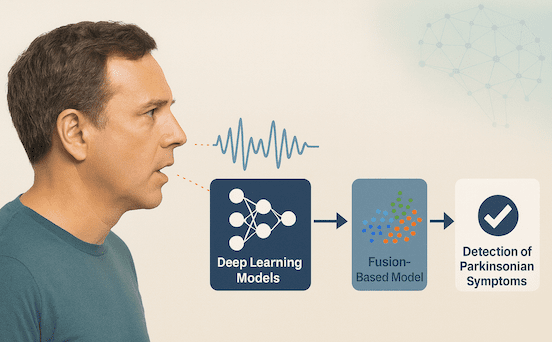
AI That Listens: Our Speech-Based Parkinson’s Study Earns Widespread Media Spotlight
Our latest publication in npj Parkinson’s Disease explores whether a short voice recording can help detect early Parkinsonian changes — and the world took notice.
What if early signs of Parkinson’s disease could be detected just by listening?
Do you use Alexa or Google Home? Would you ever opt in to have it analyze your speech and warn you if you’re showing early signs of Parkinson’s disease? The reality is closer than you think.
That’s the question our team set out to explore — and the answer has captured widespread attention.
In our study, we demonstrated that AI can detect Parkinson’s from speech with 86% accuracy, using only a short English pangram recorded using day-to-day devices under real-world variability.
Given that Parkinson’s is the fastest-growing neurological disability worldwide, this opens up exciting possibilities for early screening—right from your living room.
The World Listened — So Did the Press
Shortly after publication, news outlets across the nation spotlighted the work and its potential impact:
- Newsweek explored how voice assistants like Alexa or Google Home might someday help flag early signs of PD.
- University of Rochester News Center highlighted the breakthrough as a major step toward accessible, at-home neurological screening.
- WXXI News covered how this technology could benefit regions with limited access to neurologists.
- Parkinson’s News Today emphasized the model’s ability to detect subtle vocal cues that traditional methods often overlook.
This wave of coverage reflects a growing global interest in AI-driven, speech-based health tools — and the promise they hold for early detection and health equity.
Beyond accuracy metrics, this study revealed several important insights about the role of speech as a digital biomarker and the real-world potential of AI-driven neurological screening:
- Speech contains subtle neurological signatures. Even a short, natural sentence carries micro-variations in articulation, timing, and voice stability that can reflect Parkinsonian motor changes.
- Everyday microphones are good enough. High-cost hardware is not required — recordings from laptops, phones, and home devices retain the necessary signal for meaningful analysis.
- Real-world diversity strengthens AI models. Our dataset spanned homes, clinics, age groups, and recording environments. This variability improved robustness and highlights the importance of inclusive data collection.
- AI can expand access to early screening — not replace clinicians. Voice-based tools can help flag individuals who may benefit from professional evaluation, especially in underserved or remote communities.
- Future health assessments can be passive and frictionless. Speech occurs naturally in day-to-day life; embedding screening into routine interactions could significantly reduce barriers to early detection.
These learnings reinforce the potential of speech as a low-burden, globally accessible pathway for neurological monitoring — paving the way for next-generation, at-home AI health tools.
A Step Toward New Possibilities
Speech is universal. Nearly every device can record it.
If a simple voice sample can help flag neurological changes earlier, we move one step closer to a world where screening is more accessible, equitable, and proactive.
We’re excited for the incredible attention this work has received — and even more excited for what comes next.
Stay tuned. The future of speech-based health screening is just beginning.